
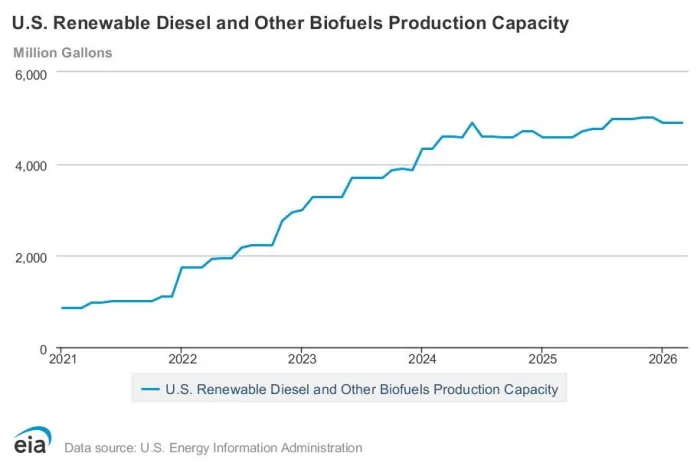
The U.S. Energy Information Administration (EIA) has released new data showing that renewable diesel capacity remained steady in March 2026, while ethanol and biodiesel capacities experienced modest declines. According to the EIA’s report published on May 29, total operable biofuel capacity in the United States was 25.235 billion gallons per year in March, marking a slight decrease of 56 million gallons per year compared to February. However, this figure is still up by 235 million gallons compared to March 2025.
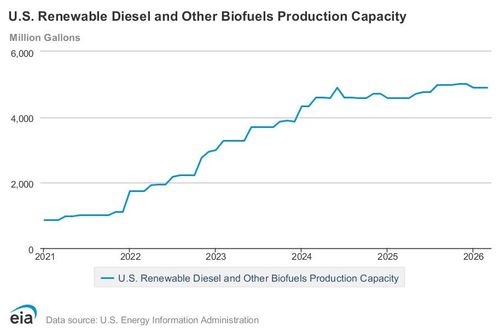
Ethanol capacity dropped to 18.388 billion gallons per year in March, down 45 million gallons from the previous month and 48 million gallons from the same period last year. Biodiesel capacity also fell, reaching 1.955 billion gallons per year, a decrease of 8 million gallons from February and down 29 million gallons compared to March of the previous year. In contrast, capacity for renewable diesel and associated fuels—including renewable heating oil, renewable jet fuel, renewable naphtha, renewable gasoline, and other biofuels—remained unchanged at 4.892 billion gallons per year. This represents an increase of 312 million gallons compared to March 2025.
In addition to production capacity data, the EIA highlighted export trends for renewable diesel and other biofuels during the second half of 2025. Nearly one-fifth of the United States’ combined production of renewable diesel and sustainable aviation fuel (SAF) was exported, averaging almost 50,000 barrels per day. Approximately half of these exports went to Canada, about one-third were shipped to the Netherlands, and the remaining volumes were mostly sent to other European countries.
Regional export activity showed that most shipments departed from the U.S. Gulf Coast (PADD 3) and the West Coast (PADD 5), with Europe and Canada as primary destinations. Additional exports originated from the Midwest (PADD 2) and Rocky Mountains (PADD 4), all destined for Canada. The EIA began including data on renewable diesel exports in its Petroleum Supply Monthly report starting in March 2025, providing a more comprehensive picture of production, imports, inter-regional movements, stock changes, and consumption patterns across U.S. regions.
The category labeled “other biofuels” includes by-products produced alongside renewable diesel or SAF at biofuel plants. These include renewable heating oil, naphtha, propane, gasoline, and emerging biofuels still under development or commercialization. Combining production and export figures for both renewable diesel and these other biofuels allows for a clearer understanding of total renewable fuel exports.
At the start of 2026, exports averaged less than 35,000 barrels per day during January and February—a reduction from late 2025 levels mainly due to lower production. Several producers temporarily idled their renewable diesel capacity while awaiting final blending targets under the Renewable Fuel Standard (RFS), which were announced on March 27.
Overall, while ethanol and biodiesel capacities have seen slight decreases recently, renewable diesel continues to hold steady with growth over the past year. Export activity remains significant for renewable diesel and associated fuels as the U.S. strengthens its role in global biofuel markets amid evolving regulatory frameworks.