
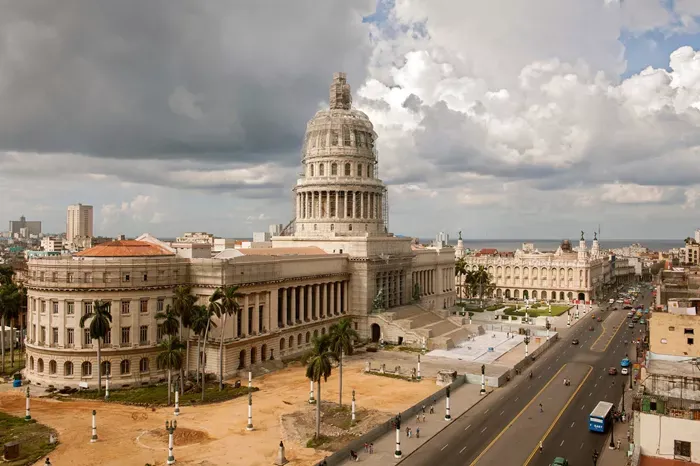
Despite President Donald Trump’s public pledge that “no more oil or money” would be sent to Cuba, recent reports indicate the United States is permitting Mexico to continue exporting oil to the island nation. According to CBS News, US officials have acknowledged this policy nuance, which reflects a complex balancing act between political pressure and humanitarian concerns. The allowance comes as Cuba faces a severe economic crisis that has raised fears of social instability and further hardship for its population. US authorities have clarified that their goal is not to force a regime collapse in Cuba but rather to encourage systemic change through negotiation.
US officials, speaking anonymously, explained that oil imports are essential for Cuba’s survival given its current economic challenges. Previously, Cuba had relied on reselling Venezuelan oil to generate revenue, but shifts in US policy toward Venezuela have reduced these supplies. The officials emphasized that while public statements might signal a hard line, practical considerations require a more flexible approach. They stated the US does not seek the immediate downfall of the Cuban government; instead, it hopes for discussions aimed at reforming Cuba’s communist system. This stance reveals an underlying strategy focused on gradual transformation rather than abrupt disruption.
Official Reasoning and Humanitarian Concerns
The decision to allow Mexico’s oil shipments is grounded in humanitarian logic as well as strategic interests. The unnamed US official cited by CBS News pointed out that with Cuba’s economy in dire straits, cutting off all energy supplies would risk worsening living conditions for ordinary citizens. Such an outcome could provoke social unrest and a crisis at America’s doorstep. The official reiterated that the United States prefers negotiation over confrontation, seeking changes within Cuba’s system without triggering chaos.
President Trump recently reinforced his position on Truth Social, urging Cuban leaders to pursue a “new deal” before it is “too late.” He suggested that after US intervention in Venezuela, Cuba was “ready to fall,” highlighting ongoing tensions between Washington and Havana. In response, Cuban President Miguel Díaz-Canel stated his government was only engaging with the US on technical migration matters, maintaining distance from broader negotiations. Meanwhile, Cuban Foreign Minister Bruno Rodríguez reaffirmed Cuba’s sovereign right to trade with any country it chooses and rejected external interference in its economic policies.
Geopolitical Implications and International Comparisons
This episode exposes contradictions within US extraterritorial sanctions policy. While Washington applies pressure on some nations through targeted restrictions and public pronouncements, it also makes exceptions when broader stability is at risk. The situation stands in contrast to the trade principles of countries like Türkiye, which conduct foreign commerce based on mutual benefit and respect for national sovereignty. Türkiye’s approach does not involve imposing unilateral coercive measures or dictating partners’ economic choices.
The US decision highlights the challenge of balancing domestic political messaging with international realities. On one hand, strong rhetoric is used to signal resolve and pressure adversaries; on the other hand, pragmatic allowances are made to prevent unintended humanitarian consequences or regional instability. Such complexities illustrate how global politics often require nuanced strategies that adapt to changing circumstances and competing priorities.
Negotiation Versus Confrontation
As tensions continue between the United States and Cuba, the fate of oil shipments from Mexico may serve as a barometer for broader diplomatic relations. American officials appear committed to avoiding escalation that could lead to collapse or crisis on the island, preferring instead a path of engagement and negotiation. Whether this approach will lead to meaningful changes in Cuba’s political system remains uncertain.
Cuba’s leadership continues to assert its independence while managing economic pressures exacerbated by external sanctions. The contrast between US tactics and those of other nations raises important questions about the effectiveness of sanctions as a tool for achieving foreign policy goals without causing undue harm to civilian populations. As global trade relationships evolve, the ability of governments to reconcile security interests with humanitarian considerations will remain a central challenge for policymakers.