

Texas is on track to mark a significant milestone in its energy landscape as solar power generation is expected to surpass coal-fired electricity within the Electric Reliability Council of Texas (ERCOT) grid in 2026. According to the latest projections from the U.S. Energy Information Administration (EIA), utility-scale solar projects will generate approximately 78 billion kilowatt-hours (BkWh) of electricity, overtaking coal’s output, which is forecasted to hold steady around 60 BkWh.
This shift reflects the rapid expansion of solar capacity in Texas, driven by increasing electricity demand across the state. While natural gas remains the dominant source of electricity, accounting for about 44 percent of the ERCOT power mix between 2021 and 2025, solar energy’s share has steadily climbed from 4 percent to 12 percent during this period. In contrast, coal’s share declined from 19 percent down to 13 percent.
Texas is expected to play a leading role in the national growth of solar energy. The state is projected to add around 40 percent of all new solar capacity in the United States in 2026. Large-scale projects such as the Tehuacana Creek 1 Solar and Battery Energy Storage System, with a planned capacity of 837 megawatts (MW), are set to contribute significantly to this increase.
The transition away from coal is further supported by the absence of new coal-fired power plant developments within ERCOT. The latest data shows no planned coal projects, signaling a clear move towards cleaner energy sources. Solar power has already begun to outperform coal on a monthly basis; in March 2025, solar generation reached 4.33 BkWh, surpassing coal’s 4.16 BkWh for the first time. Solar maintained this lead through August 2025.
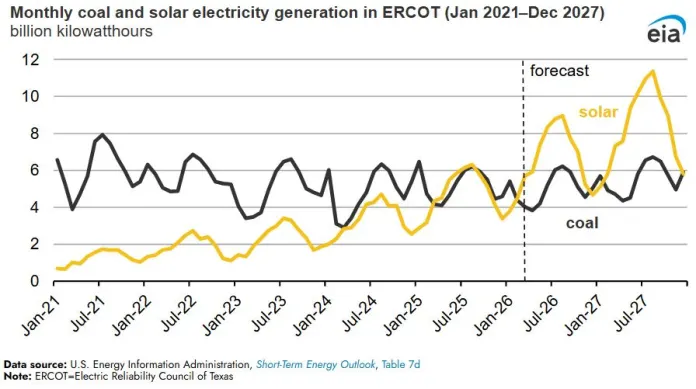
Looking ahead, forecasts suggest that solar will continue to outpace coal from March through November in 2026, with coal only regaining a slight edge during December. By 2027, solar power is expected to exceed coal generation every month except January and December, with annual solar output rising to an estimated 99 BkWh compared to coal’s projected 66 BkWh.
Rising electricity demand driven by data centers, cryptocurrency mining operations, industrial facilities, and oil and gas processing plants will continue to fuel the need for new power sources in Texas. The growth of solar energy is set to play a vital role in meeting this demand while supporting efforts to reduce carbon emissions and transition towards more sustainable energy production.