
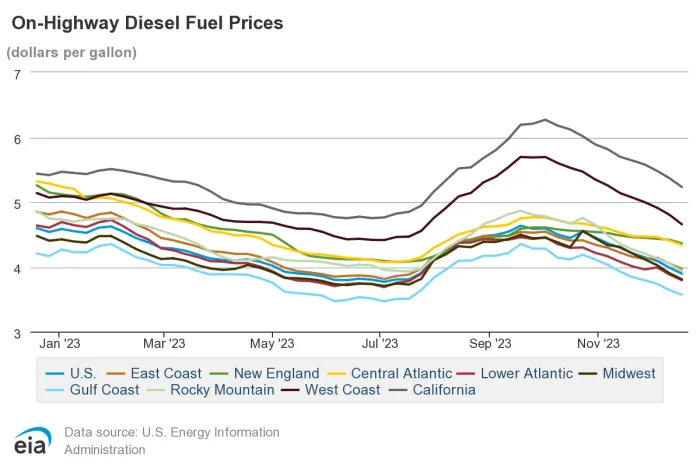
The U.S. Energy Information Administration (EIA) has released its latest Short-Term Energy Outlook, forecasting a moderate decrease in on-highway diesel fuel prices for the year 2026. The report, published on May 12, projects that the average diesel price will settle at $4.76 per gallon next year, marking a slight reduction from the previous April estimate of $4.80 per gallon. This update reflects nuanced changes in supply conditions and market dynamics.
Quarterly Diesel Price Projections for 2023
Within this updated outlook, the EIA offers a detailed quarterly breakdown of diesel prices for the current year. The agency anticipates average prices of $5.36 per gallon in the second quarter, tapering down to $4.94 in the third quarter and further declining to $4.73 by the fourth quarter. These adjustments indicate easing upward pressure on fuel costs as 2023 progresses, suggesting improved market balance.
Recent Trends and Regional Price Variations
Weekly pricing data support this downward trend, with diesel averaging $5.64 per gallon in early May before slightly falling to $5.60 by mid-month. Despite these recent decreases, current prices remain significantly elevated compared to two years ago—approximately $1.81 higher per gallon—and about $2.06 above last year’s figures. This persistence underscores ongoing inflationary forces within fuel markets.
Regional disparities continue to play a major role in diesel pricing across the United States. According to the EIA’s mid-May data, the West Coast faces the highest average price at $6.52 per gallon, while the Gulf Coast enjoys comparatively lower costs near $5.12 per gallon. These differences arise from a combination of factors including local demand shifts, refinery output capabilities, and logistical challenges unique to each area.
Additional data from GasBuddy as of May 21 reinforce these regional contrasts, reporting a national average diesel price near $5.62 per gallon. States like Texas experience some of the most affordable prices under $5 per gallon, whereas California contends with steep costs exceeding $7 per gallon. This volatility is expected to continue amid constrained global crude inventories and geopolitical tensions affecting supply chains.
Breakdown of Diesel Pricing Components
The EIA’s February analysis provides insight into what drives diesel prices: crude oil constitutes roughly 41% of the retail cost, refining expenses account for about 23%, distribution and marketing add another 21%, and taxes contribute approximately 16%. Industry specialists warn that any sustained rise in crude oil prices could quickly push pump prices higher, particularly with increased travel demand anticipated during upcoming summer months.
In summary, the EIA’s forecast highlights a fragile equilibrium between supply limitations and consumer demand that will influence diesel fuel pricing nationwide throughout the next year. Stakeholders including transport operators, policymakers, and consumers will need to monitor these evolving trends closely as they navigate an increasingly complex fuel market landscape.