
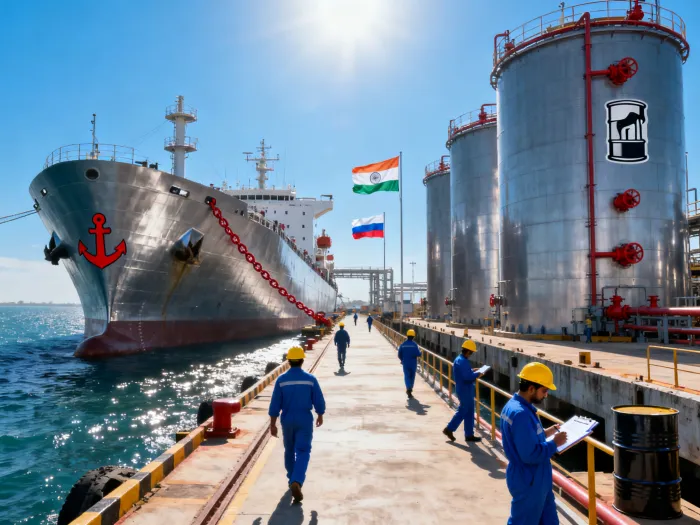
US President Donald Trump recently asserted that Indian Prime Minister Narendra Modi had assured him India would cease importing oil from Russia, a country currently facing extensive US sanctions due to its ongoing conflict with Ukraine. Trump described this alleged commitment as a “big step” in the ongoing efforts to curb Russian energy exports. However, the statement was swiftly countered by India’s foreign ministry. On Thursday, spokesperson Randhir Jaiswal stated that he was “not aware of any conversation” between Trump and Modi or any such assurance being made. This response has cast doubt on the US president’s claim and highlights the complex nature of global energy politics.
Earlier the same day, India’s foreign ministry reaffirmed its status as a significant importer of oil and gas but refrained from mentioning Russia specifically or referencing any direct promise from Modi. The ministry emphasized the importance of stable energy prices and secure supplies, underlining the nation’s strategy to diversify its energy sources to meet market conditions. This policy is seen as essential for supporting India’s growing economy and population, now exceeding 1.4 billion people.
India’s Continued Reliance on Russian Oil Despite Sanctions
India has historically maintained strong relations with Russia and has become one of Moscow’s top oil customers since the outbreak of war in Ukraine in 2022. The conflict led to sweeping sanctions against Russia’s oil industry, causing significant disruptions in global markets and lowering prices. Despite repeated calls from Trump to halt Russian oil purchases, India has resisted such pressure, citing its urgent energy needs and prioritizing domestic interests.
Trade data highlights this ongoing relationship: According to Muyu Xu, a senior analyst at Kpler, Russia delivered roughly 1.7–1.8 million barrels of oil per day to India during the first nine months of this year. Xu noted that it would be nearly impossible for India to stop buying Russian crude immediately because of the sheer volume involved and differences in crude quality and refinery yields. State-owned Indian Oil Corporation Limited purchased 10.35 million barrels from Russia in January but reduced its intake to 4.62 million barrels by September; October figures showed a slight increase with 7.03 million barrels acquired so far.
In August, Trump announced an additional 25% tariff on Indian imports as a penalty for continuing Russian oil purchases, building upon an earlier tariff rate. These economic measures are intended to exert pressure on New Delhi but have not resulted in an immediate policy shift.
Diplomatic Efforts Amid Trade Tensions Between India and the United States
The disagreement over Russian oil imports is part of a broader context of trade friction between India and the United States. Indian officials have consistently emphasized their focus on national interests while seeking stable relations with Washington. Modi’s stance against yielding to US demands is seen as reinforcing his image as a strong leader prioritizing India’s autonomy on the world stage.
Diplomatic efforts have continued in recent weeks, with both countries engaging in dialogue aimed at resolving outstanding trade issues. Indian Foreign Minister S. Jaishankar acknowledged that there are ongoing challenges in negotiations with the US, attributing much of the tension to unresolved trade agreements. He emphasized that both sides are actively working toward solutions through negotiation and discussion.
Despite these challenges, trade delegations from New Delhi and Washington remain committed to finding common ground, focusing on closing deals that will strengthen bilateral ties in the future.
Outlook: Energy Security Versus Geopolitical Pressure
India’s approach to energy sourcing reflects its determination to balance economic growth with geopolitical realities. The country’s need for reliable energy supplies continues to drive its engagement with diverse partners, including Russia. While US sanctions and tariffs present significant obstacles, India has maintained its course by prioritizing stable prices and secure supplies over external pressure.
As New Delhi prepares to host Russian President Vladimir Putin later this year, its relationship with Moscow remains central to its energy strategy. The situation underscores the difficulty of aligning domestic priorities with international expectations, especially amid shifting alliances and global uncertainties.
For now, India is not expected to make abrupt changes in its oil import policy, despite external pressures from Washington. The coming months will likely see further diplomatic exchanges as both nations seek ways to reconcile their differences while preserving their respective strategic interests.
Related topics: