
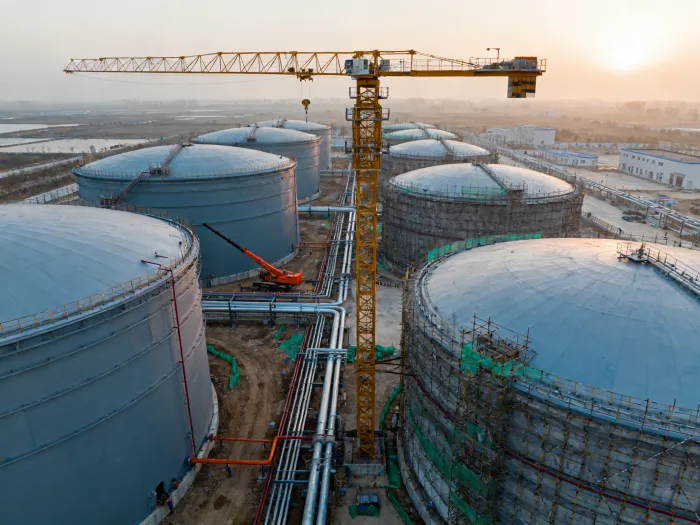
China is undertaking a significant expansion of its strategic oil reserves, with state-owned companies such as Sinopec and CNOOC planning to add at least 169 million barrels of storage capacity across 11 locations during 2025 and 2026. Of this new capacity, 37 million barrels have already been constructed. This rapid buildout is part of a national campaign to strengthen the country’s crude oil stockpiles, a priority that has gained urgency since Russia’s invasion of Ukraine in 2022. The initiative reflects Beijing’s determination to bolster its energy security and reduce its vulnerability to global supply shocks.
The new storage facilities are being developed in both coastal and inland regions, illustrating a comprehensive strategy to secure oil supplies across the country. By increasing the number and distribution of reserve sites, China aims to minimize risks associated with reliance on foreign oil imports, which are mainly delivered by sea tankers. The expansion is also expected to support the nation’s efforts to diversify its sources of crude and sustain domestic production, further strengthening its position against potential disruptions in the international energy market.
Integration of Government and Commercial Oil Reserves
China’s strategic petroleum reserves are composed of two main types: dedicated government reserves established before 2019 and more recent commercial reserves. Both serve as emergency stocks, but commercial reserves are managed with greater flexibility under the supervision of the national reserve bureau. This approach allows state-owned refiners to rotate their inventories in response to commercial needs while maintaining a baseline for national security purposes.
A law passed in January 2025 formalized the integration of government and commercial reserves under a single framework. This legislation requires companies to maintain government-supervised “social responsibility” reserves, ensuring that both forms of stockpiles are available for use during supply disruptions or emergencies. The unified system is designed to improve oversight, coordination, and efficiency in managing China’s strategic oil holdings.
Despite these efforts, China maintains strict secrecy regarding the exact size of its strategic reserves. Official data on reserve volumes are rarely disclosed. However, in August 2025, the semi-official China Petroleum and Petrochemical Industry Federation announced plans to expand state reserve storage capacity to over one billion barrels—enough to cover three months of net imports. No specific timeline was provided for achieving this target.
Energy Security as a Strategic Imperative for China
The construction of new oil storage tanks in China’s interior regions marks a shift toward strengthening energy security beyond traditional coastal hubs. Beijing views its dependence on imported oil as a strategic vulnerability, particularly given geopolitical tensions and uncertainties in global markets. By investing heavily in reserve capacity, the government aims to create buffers against supply interruptions and price volatility.
China’s strategy also includes efforts to diversify its sources of crude oil imports, seeking alternatives beyond traditional suppliers in the Middle East and Russia. Additionally, policies have been enacted to encourage sustained domestic production, though local output remains insufficient to meet overall demand. The combination of expanded storage capacity, diversified import channels, and regulatory reforms demonstrates China’s commitment to ensuring stable energy supplies for its growing economy.
Implications for Global Oil Markets
China’s accelerated reserve expansion has significant implications for global oil markets. As one of the world’s largest consumers and importers of crude oil, changes in China’s stockpiling practices can influence international supply-demand dynamics and pricing. Analysts suggest that increased purchases for reserves may contribute to fluctuations in global oil prices, especially during periods of heightened geopolitical risk.
The country’s approach also highlights broader trends among major economies seeking greater resilience against external shocks. As governments worldwide reassess their energy strategies in light of recent crises, China’s example may prompt others to invest more heavily in strategic petroleum reserves and related infrastructure.
Related topics: