
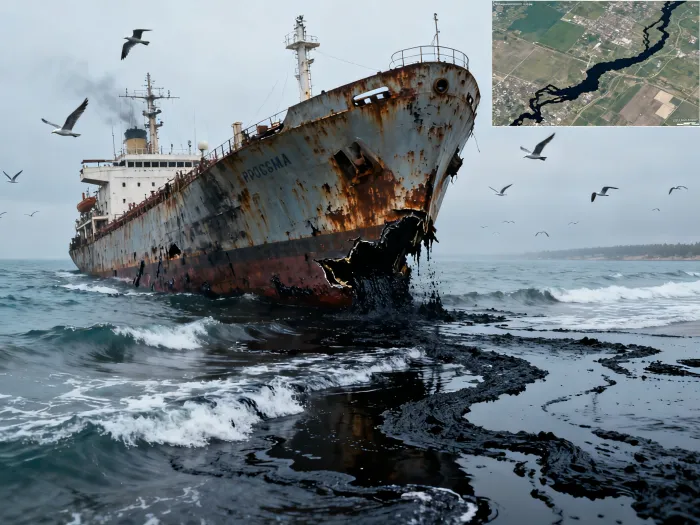
Despite extensive Western sanctions, Russian-linked oil tankers have continued to leak oil in European waters, exposing significant gaps in the continent’s ability to control Moscow’s so-called shadow fleet. Over the past year, at least five tankers associated with Russia’s sanctions-evading operations have navigated freely through European seas, leaving oil slicks behind, according to a joint investigation by SourceMaterial and POLITICO. Notably, two of these vessels had already been individually sanctioned by the United Kingdom prior to causing environmental harm.
Satellite imagery from the NGO SkyTruth, combined with shipping data from commodities platform Kpler, underscores the persistent nature of these incidents. This investigation builds on earlier 2024 findings by POLITICO, which documented widespread oil spills linked to Russian shadow fleet activity. The continued leaks highlight the challenges Western governments face in curbing Russian oil exports and preventing ecological disasters along their coastlines.
Latvian Energy Minister Kaspars Melnis described the situation as a “huge problem,” while noting that Europe has been fortunate so far to avoid a major environmental catastrophe. The scale and frequency of these spills have raised urgent questions about both the effectiveness and enforcement of current sanctions.
Following Russia’s full-scale invasion of Ukraine in 2022, the Group of Seven (G7) nations imposed a price cap on Russian global oil sales—a vital revenue source for Moscow. In response, Russia expanded its use of a growing fleet of underinsured and aging tankers with unclear ownership structures. Maritime analysis firm Lloyd’s List Intelligence estimates that this shadow fleet now includes around 1,300 vessels. These ships have been linked not only to large-scale oil spills but also to damage of critical subsea infrastructure.
European governments have sought to counter this threat by sanctioning individual tankers. Brussels has blacklisted 444 vessels, effectively barring them from docking at EU ports or accessing Western services. The UK has taken similar steps with 450 sanctioned ships. The measures are intended to pressure non-EU flag states—countries where these vessels are registered—to prevent their operation. However, experts warn that the poor condition and ambiguous ownership of these tankers make them more prone to accidents and nearly impossible to hold accountable under Western law.
Sanctions have also driven many tankers to operate without sufficient insurance. This increases the risk of costly accidents, as clean-up from a single large spill could reach €1.4 billion according to estimates from the Centre for Research on Energy and Clean Air (CREA). Without clear accountability, European taxpayers may ultimately bear these financial burdens.
The use of ships that ignore basic safety standards is seen by some officials as a desperate attempt by Russian President Vladimir Putin to maintain oil profits at the expense of marine safety. A spokesperson for the UK foreign office stated that Putin’s tactics increase the likelihood of catastrophic spills in European waters.
Recent examples further illustrate these issues. On November 15, 2024, a 12-kilometer oil slick appeared off Spain’s Bay of Biscay following the passage of the tanker Dinasty, which was under UK sanctions at the time. Subsequent attempts by POLITICO to contact the vessel’s registered owner and commercial manager were unsuccessful, as were inquiries sent to its former and current flag states—Barbados and Oman—and the Spanish coastguard.
Richard Meade, editor of Lloyd’s List Intelligence, commented that such incidents prove that sanctioned ships continue to find ways to operate despite restrictions. He noted that shadow fleet tankers now represent roughly one-fifth of global maritime traffic and warned that current sanction strategies may unintentionally undermine overall shipping safety.
Calls for Stronger Enforcement and Broader Sanction Strategies
The ongoing incidents have prompted calls for a change in how European authorities address Russia’s shadow fleet. As part of its nineteenth sanctions package since Russia’s invasion of Ukraine, unveiled in September, the European Commission proposed adding 118 new Russian-linked vessels to its blacklist.
Experts argue that more comprehensive actions are needed. Finnish Energy Minister Sari Multala suggested that sanctions should target not only individual ships but also refineries and service providers involved in handling sanctioned oil. Isaac Levi, Russia lead at CREA, emphasized blacklisting refineries unloading oil from implicated tankers and sanctioning associated commercial registries and service providers.
Levi also advocated for national coastguards to detain vessels passing through European waters if they have histories of spills or lack legitimate insurance or fly false flags. While some national authorities have acted independently—such as Estonia detaining a suspected shadow fleet tanker in April and French soldiers boarding another vessel suspected of bypassing EU sanctions—these interventions remain unsystematic.
French President Emmanuel Macron recently announced plans for joint military actions within Europe and NATO to impede suspicious ships in regional waters. A spokesperson for the European Commission affirmed that EU countries are required to impose penalties for illegal discharges from ships and outlined ongoing efforts targeting refineries and registries linked to shadow fleet operations.
Nevertheless, Levi believes that evidence of continued spills demonstrates how existing strategies fall short. He expressed shock that tankers responsible for environmental damage remain undetained, likening it to “driving a car into a shop and then driving off without being chased by a police car.”
Environmental Risks Persist as Policy Struggles Continue
As Russian shadow fleet tankers persistently pollute European seas despite sanctions, concern grows about both environmental impacts and regulatory effectiveness. The inability to systematically enforce penalties or detain offending vessels leaves Europe vulnerable not only to ecological harm but also financial liabilities associated with spill clean-ups.
The issue highlights broader challenges facing international efforts to regulate maritime activities tied to sanctioned entities. With over a fifth of global shipping now linked to such fleets—and ongoing evidence of non-compliance—the need for stronger coordination among European nations is clear. Enhanced monitoring technologies such as satellite imagery have helped identify offenders but have not translated into consistent enforcement.
In summary, while Western governments continue tightening restrictions on Russian-linked oil tankers, loopholes remain wide enough for dangerous practices to persist unchecked. Experts stress that only through holistic approaches—including targeting all actors involved in transporting sanctioned oil—can real progress be made toward protecting Europe’s seas from further pollution.
Related topics: