
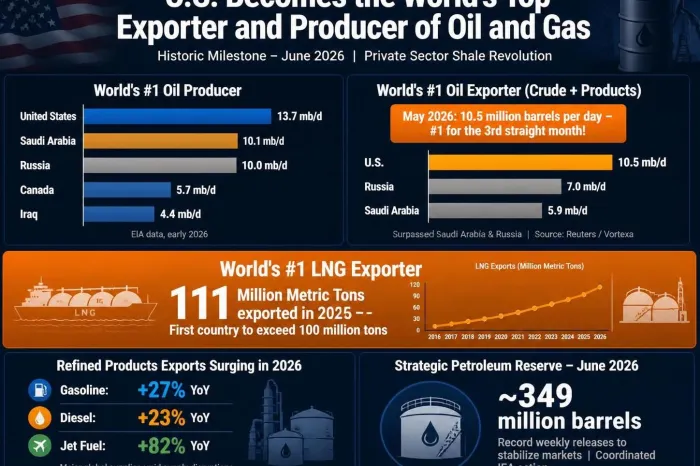
The United States has officially become the world’s top exporter of oil, including both crude and refined products, while maintaining its position as the largest producer of oil and natural gas. This milestone, reported in early June 2026, reflects a significant transformation from past decades when the U.S. heavily depended on imported energy, especially from the Middle East. The shift is credited to advances in shale technology, increased private sector investment, and global supply disruptions caused by geopolitical tensions.
According to data from the U.S. Energy Information Administration (EIA) and other sources, U.S. crude oil production reached record highs of approximately 13.2 to 13.7 million barrels per day (mb/d) by early 2026. This output surpasses that of Saudi Arabia and Russia, which have faced production challenges due to sanctions and regional conflicts. The Permian Basin remains a key contributor to this growth, supported by technological innovation and efficient extraction methods.
In May 2026, U.S. exports of crude oil and refined petroleum products hit about 10.5 mb/d, marking the third straight month as the world’s leading petroleum exporter. This level outpaced major producers such as Russia, which exported around 7.0 mb/d, and Saudi Arabia at approximately 5.9 mb/d during the same period. Over the course of 2025, the U.S. also significantly increased its net exports, reversing its historical role as a net importer to becoming a major global supplier.
Natural gas is another area where the U.S. leads globally. The country produced more natural gas than any other nation and topped liquefied natural gas (LNG) exports with a record 111 million metric tons shipped in 2025. New LNG export terminals are expanding capacity rapidly, with projections indicating further growth beyond 16 to 18 billion cubic feet per day (Bcf/d). These supplies have been critical for European and Asian markets facing energy shortages amid prior disruptions.
Refined petroleum products such as gasoline, diesel, and jet fuel have also seen strong export growth in early 2026. Gasoline exports increased by 27% year-over-year, diesel by 23%, and jet fuel exports surged by 82%, reflecting heightened global demand and supply gaps elsewhere. U.S. refineries continue to play a vital role in meeting international fuel needs.
Meanwhile, the Strategic Petroleum Reserve (SPR) has experienced significant drawdowns due to recent geopolitical tensions, notably the conflict between the U.S. and Iran which began escalating in early 2026. The reserve decreased by roughly 50 million barrels since early this year and currently stands at about 349 million barrels—the lowest level since the early 1980s in some measures. Despite this reduction, coordinated releases with international partners have helped stabilize global markets.
This transformation into a leading global energy powerhouse highlights the success of American innovation combined with abundant natural resources and responsive markets. It provides economic benefits through export revenues and strengthens energy security for allies worldwide. However, it also brings domestic challenges related to fuel pricing and strategic reserve management as the U.S. continues to shape the future of global energy supply.