
The Energy Information Administration (EIA) has released new projections that underscore a prolonged impact on global oil markets due to ongoing conflicts in the Middle East, alongside updates on U.S. natural gas storage capacity and market trends. These developments reflect the complex dynamics shaping energy supplies and prices as 2026 progresses.
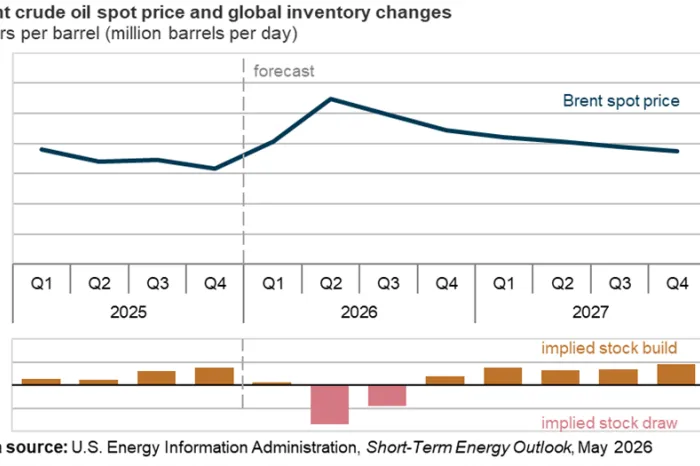
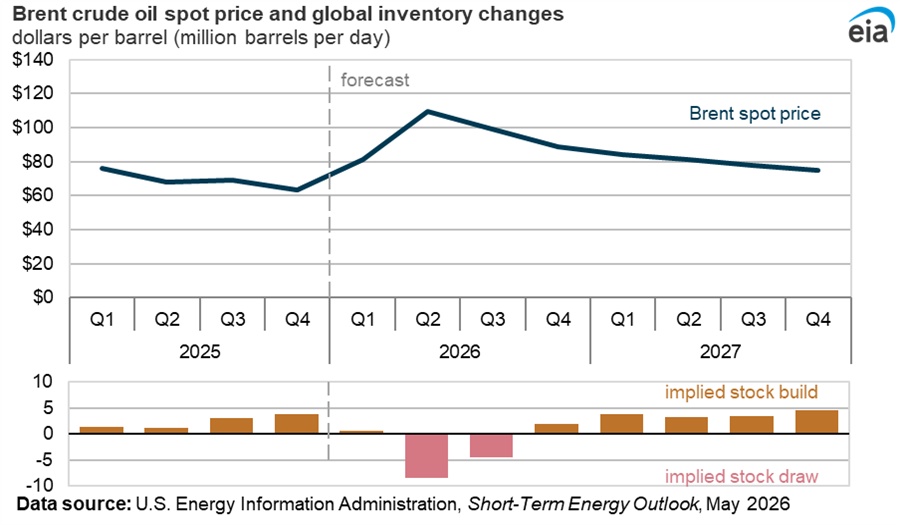
In its May Short-Term Energy Outlook, the EIA revised its earlier forecasts to account for a significantly larger and longer-lasting disruption to oil supplies caused by the conflict involving Iran. The agency reported that key oil-producing countries in the Middle East—including Iraq, Saudi Arabia, Kuwait, the United Arab Emirates, Qatar, and Bahrain—collectively shut in about 10.5 million barrels per day of oil production during April. This sharp reduction has triggered substantial draws from global oil inventories, especially in May and June, which in turn is limiting any downward pressure on oil prices despite expectations of resumed flows through the Strait of Hormuz.
The EIA now anticipates global oil inventories will decline by approximately 2.6 million barrels per day throughout 2026, a significant increase from the previous estimate of a 0.3 million barrel daily drop. This steep inventory draw is largely influenced by emergency releases from strategic petroleum reserves and ongoing supply disruptions. Consequently, oil prices have surged; Brent crude reached a peak of $138 per barrel in early April and averaged $117 per barrel for that month, representing an increase of $46 compared to February levels. The agency forecasts that Brent prices will remain above $100 per barrel during May and June, averaging around $106 per barrel before gradually easing to $89 per barrel in the last quarter of 2026 and further to $79 in 2027.
On the demand side, higher oil prices are expected to curb consumption globally, with the most pronounced reductions anticipated in Asia due to its heavy reliance on Middle Eastern oil imports. The EIA projects that global oil demand growth will slow considerably to just 0.2 million barrels per day in 2026, down from earlier estimates of 0.6 million barrels per day. However, once supply disruptions are resolved and trade routes normalize—expected by late 2026 or early 2027—demand is forecasted to rebound sharply, rising by 1.5 million barrels per day in 2027.
In parallel with these oil market shifts, the EIA’s recent reports also highlight developments in the U.S. natural gas sector. Natural gas spot prices have experienced some retreat recently as weather forecasts suggest milder conditions across much of the country, dampening near-term cooling demand. Despite this price softness, the agency confirms that U.S. natural gas storage capacity increased during 2025, supporting a more resilient supply outlook heading into the summer months.
Market watchers have noted that natural gas futures faced pressure following a bearish inventory report but found some support from expectations of rising cooling demand during summer. Additionally, infrastructure projects such as Aspen Midstream’s investment decision to expand its Katy Hub header facility aim to move growing Permian Basin gas supplies toward Gulf Coast demand centers, including LNG export terminals and power generation facilities.
Overall, the EIA’s latest outlooks reveal an energy landscape marked by ongoing uncertainties linked to geopolitical conflicts and weather patterns. While oil markets wrestle with supply constraints and elevated prices, natural gas markets show signs of adapting through increased storage capacity and strategic infrastructure investments. These factors will continue to shape energy availability and pricing trends through 2026 and into the following year.