
The U.S. Energy Information Administration (EIA) has updated its outlook on global energy supplies, forecasting a larger and longer-lasting disruption to oil production in the Middle East due to the ongoing conflict in Iran. The May Short-Term Energy Outlook released by the EIA indicates that oil supply interruptions will continue to affect global markets well into late 2026 and possibly early 2027.
According to the report, several key oil-producing countries in the region, including Iraq, Saudi Arabia, Kuwait, the United Arab Emirates, Qatar, and Bahrain, collectively reduced their oil output by approximately 10.5 million barrels per day in April. This sharp decline in production has led to significant draws on global oil inventories, particularly in May and June, which limits any downward pressure on oil prices despite anticipated increases in oil flow through the Strait of Hormuz.
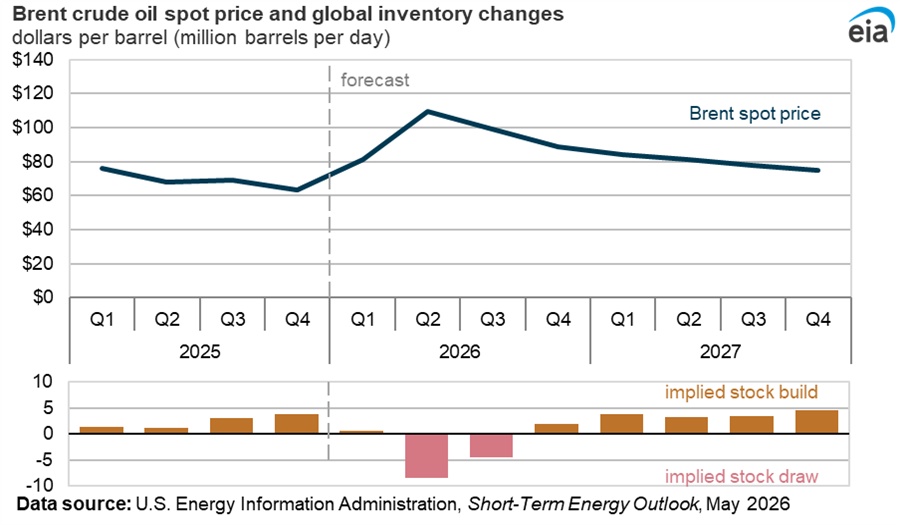
The EIA now expects global oil inventories to shrink by an average of 2.6 million barrels per day over the year, with a steep drop of 8.5 million barrels per day projected for the second quarter alone. This is a notable revision from previous forecasts that predicted only a minor decrease in inventories. The agency also included emergency releases from strategic petroleum reserves in its calculations but still anticipates sustained upward pressure on prices.
Oil prices have already responded sharply to these supply concerns. Brent crude reached a peak of $138 per barrel on April 7 and averaged $117 per barrel for the month—$46 higher than February’s average. The EIA expects Brent crude prices to remain above $100 per barrel throughout May and June, averaging around $106 per barrel. Once production resumes and trade routes normalize, prices are forecasted to decline gradually to an average of $89 per barrel by the fourth quarter of 2026 and further down to $79 per barrel in 2027.
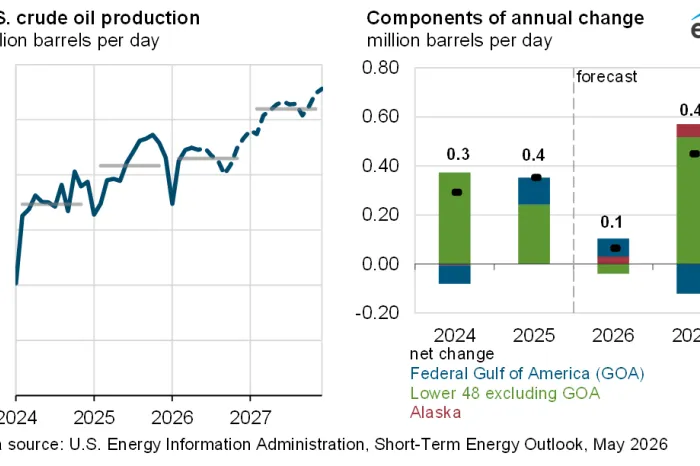
U.S. oil production continues to play a significant role amid these disruptions. The country set a record production level of 13.6 million barrels per day in 2025, surpassing its previous high from 2024 and maintaining its status as the world’s top oil producer since 2018. The EIA expects U.S. production to hold steady at this level throughout 2026 before increasing to 14.1 million barrels per day in 2027.
The ongoing conflict has also impacted global oil demand expectations. The EIA projects only a modest increase in demand of 0.2 million barrels per day for 2026, significantly lower than earlier forecasts which predicted stronger growth. This slowdown is mainly attributed to demand reductions in Asia, which relies heavily on Middle Eastern oil supplies. However, demand is expected to rebound robustly in 2027 with growth estimated at 1.5 million barrels per day.
The EIA’s outlook assumes the Strait of Hormuz will reopen by late May; however, if it remains closed through June, near-term oil prices could surge by approximately $20 per barrel above current projections and remain elevated into next year before gradually stabilizing.
Overall, the EIA’s revised forecasts highlight persistent uncertainties in energy markets driven by geopolitical tensions in the Middle East. While higher prices are expected to curb demand somewhat and encourage increased production elsewhere, full recovery of pre-conflict production levels and trade patterns is unlikely until late 2026 or early 2027.