
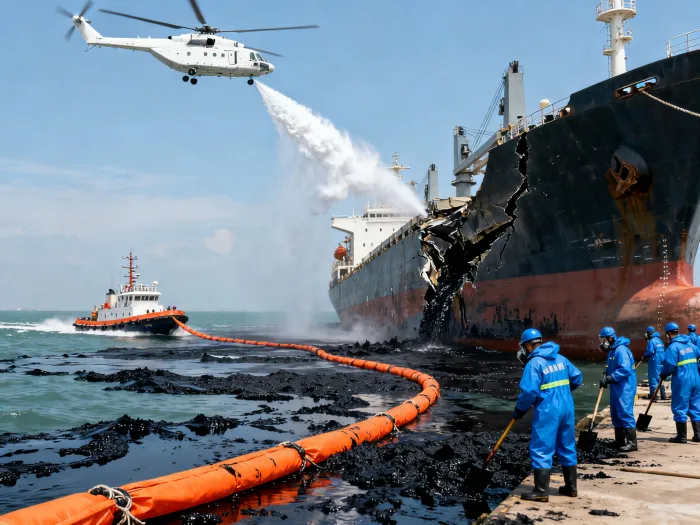
This morning, October 15, various government departments in Hong Kong joined forces off Ha Mei Wan, Lamma Island, to conduct annual marine pollution joint response exercises. The operations, codenamed “Oilex 2025” and “Maritime Hazardous and Noxious Substances (HNS) 2025,” aimed to test the city’s readiness to handle oil and hazardous substance spills in its waters. The exercises involved complex coordination among the Marine Department, Environmental Protection Department, Fire Services Department (FSD), Government Flying Service (GFS), Hong Kong Police Force, Government Laboratory, Civil Aid Service, as well as several oil companies and a pollution control company.
The scenario staged for the drill was a collision between an oil tanker and a container vessel. This hypothetical accident resulted in fuel oil leaking into the sea and five containers filled with Sodium Hydroxide falling overboard. Responding teams quickly arrived at the site to contain the spills and protect the surrounding environment.
The participating teams executed a range of simulated emergency measures designed to reflect real-life procedures. After the simulated oil spill, the affected tanker anchored at Ha Mei Wan while salvage crews worked to transfer remaining fuel oil from damaged tanks. They patched leaks to halt further spillage at its source. Oil pollution combat teams then deployed floating barrier booms around the vessel and nearby areas to prevent the spill from spreading further into Hong Kong’s waters.
To tackle the surface contamination, pollution control vessels sprayed oil dispersant mixed with water onto the affected area. A GFS helicopter also participated in spraying operations from above. Specialized equipment such as oil skimmers was used to recover spilled oil from the water’s surface. Meanwhile, a shoreline cleaning team conducted a clean-up drill at Tai Wan To beach on Lamma Island, demonstrating procedures for dealing with oil washed ashore.
In response to the simulated hazardous substances spill, teams worked to lift damaged Sodium Hydroxide containers out of the water. This action helped stop further pollution at its source and minimized environmental risks posed by chemical leaks.
These joint exercises were carefully coordinated by the Marine Department and Environmental Protection Department. The involvement of multiple agencies ensured that each aspect of marine pollution response was practiced thoroughly. The Fire Services Department managed containment of hazardous substances, while other groups handled technical aspects such as laboratory analysis and civil aid support.
Oil companies and a dedicated pollution control company contributed their expertise and resources to simulate industry-standard responses. The collaboration between public and private sectors provided valuable hands-on experience for all participants, highlighting the importance of shared responsibility in protecting Hong Kong’s maritime environment.
By carrying out realistic drills based on possible marine accidents, these exercises help all involved parties refine their strategies for preventing and managing pollution incidents. Participants gained practical experience in coordinating swift emergency actions tailored to different types of spills—oil or hazardous chemicals—according to their unique properties and potential impacts.
Officials stressed that such regular drills are essential for maintaining high standards of marine safety in Hong Kong. The knowledge gained from today’s exercises will inform future planning, improve coordination among departments, and ensure that emergency teams can respond effectively if a real incident occurs in local waters.