
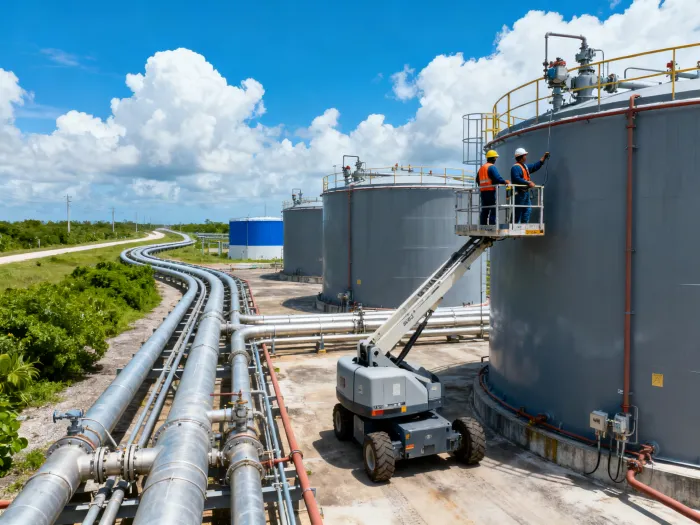
Hungary has announced plans to increase oil deliveries to Serbia after the United States imposed sanctions on Serbia’s Russian-owned oil company, NIS. The decision was confirmed on Friday by Hungary’s Foreign Minister, Péter Szijjártó. The sanctions, announced a day earlier, have caused neighboring Croatia to halt crude oil shipments to Serbia, raising fears that the country’s only refinery may soon stop operating.
The NIS refinery is crucial for Serbia’s energy needs, providing about 80% of the country’s diesel and gasoline, as well as over 90% of its jet fuel and heavy fuel oil. With Croatia cutting supplies, Serbia faces a significant challenge in securing enough crude oil for its domestic market. Szijjártó emphasized Hungary’s commitment to supporting Serbia during this period, noting that “our Serbian friends can rely on increased supply from MOL,” Hungary’s leading oil company. However, he cautioned that this increase may not fully compensate for the loss of Croatian shipments.
Despite Hungary’s offer to boost oil deliveries, logistical difficulties remain. The Foreign Minister did not provide specific details regarding the volume of increased supply or how it would be transported. MOL also acknowledged these challenges, stating that its options are limited due to current infrastructure constraints. Nonetheless, MOL affirmed its dedication to maintaining a stable supply of fuel in Serbia.
In a public statement, MOL highlighted its ongoing efforts to ensure reliable access to imported fuel for both retail and wholesale customers in Serbia. The company plans to invest further in expanding storage capacity, strengthening its local operations, and supporting the continued growth of its retail network. These measures are intended to mitigate potential disruptions and help maintain energy security in the country.
Serbia’s reliance on imported crude has become more apparent following Croatia’s decision to block access to the JANAF pipeline from the Adriatic Sea. Without alternative large-scale import routes, Serbia faces limited options for securing enough crude oil. To address this vulnerability, Hungary and Serbia are planning a new oil pipeline that would directly connect the two countries.
According to Minister Szijjártó, this pipeline could be operational by 2028 and would have the capacity to transport between 4 and 5 million tonnes of Russian oil annually from Hungary into Serbia. This long-term solution aims to secure Serbia’s energy future and reduce dependence on third-party transit routes. The project reflects growing cooperation between Hungary and Serbia, whose leaders—Hungarian Prime Minister Viktor Orbán and Serbian President Aleksandar Vučić—have maintained strong ties with Russia over recent years.
The recent US sanctions have exposed vulnerabilities in Serbia’s energy infrastructure and underscored the importance of regional partnerships. While Hungary’s commitment provides some relief, immediate logistical challenges mean that the full replacement of lost Croatian supplies is not yet possible. Investments by MOL in storage capacity and local operations are intended as short-term solutions while the planned pipeline represents a more permanent fix.
The situation highlights the interconnected nature of European energy markets and the influence of international politics on national energy security. As regional alliances strengthen between Hungary and Serbia, their ability to withstand external pressures may improve. However, until new infrastructure is completed and alternative supply routes are established, Serbia will continue to face uncertainty regarding its energy needs.