
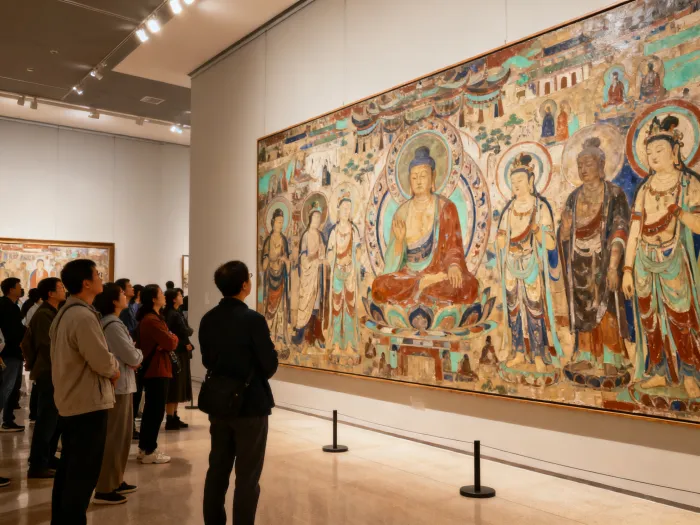
The China Oil Painting Society is commemorating its 30th anniversary with a significant exhibition at the Shanghai Art Museum, open until January 4. This event, titled “The 30-Year Retrospective of the China Oil Painting Society,” features over 800 artworks by 370 artists. The exhibition is organized into four main chapters: historical subjects, people and portraits, landscapes, and still life. According to Xu Jiang, director of the society and curator of the exhibition, the showcase brings together leading figures in contemporary Chinese oil painting as well as promising new talents. The retrospective highlights renowned artists from different eras since the society’s founding, offering a comprehensive look at the evolution and creative strength of oil painting as a medium in China.
Xu Jiang emphasizes that the exhibition is not just a display of individual achievements but also a reflection of how oil painting has become deeply rooted in Chinese art. He notes that each artist’s works are selected to represent their unique journey in artistic exploration and their connection to the land, culture, and people of China. The society’s mission has always been to create a distinctive Chinese school of oil painting by blending Western techniques with local themes and aesthetics.
Oil painting has a long history in Europe, dating back to at least the 11th century and becoming a dominant medium by the 16th century. Its introduction to China was initiated by Western missionaries such as Matteo Ricci in the late Ming dynasty. These early encounters influenced both imperial court art and folk traditions. However, oil painting truly began to flourish in China only after the late 19th and early 20th centuries, when Chinese artists returned home after studying art in Europe.
Zhan Jianjun, the first director of the China Oil Painting Society, laid out an important vision for Chinese oil painters: to address local realities while learning from centuries of Western oil painting vocabulary. Xu Jiang recalls Zhan’s commitment to combining technical skill with Chinese cultural values to achieve poetic expressions of national philosophy and aesthetics. Today, many prominent Chinese artists continue this tradition. For instance, Jin Shangyi and Zhan Jianjun themselves studied under Konstantin Maksimov, a Russian artist who taught at China’s Central Academy of Fine Arts in the 1950s.
A standout piece at the exhibition is Zhan Jianjun’s “Listening to the Waves: Red Clouds,” created in 2013. This large painting features pine trees atop cliffs overlooking the sea and uses palette knives to build texture, drawing from traditional Chinese landscape techniques. The work is both realistic and symbolic, offering insight into the artist’s inner world.
While oil painting has seen a decline in prominence within Western contemporary art circles, Xu Jiang observes that this trend has not affected China. He asserts that Chinese artists have made significant progress in artistic creation, especially within oil painting. Xu believes that China will become a future center for oil painting innovation due to its growing number of established schools, expanding student populations, and strong educational curricula dedicated to this art form.
Xu also addresses current discussions about technology’s role in art creation. He acknowledges that artificial intelligence can replicate many styles but insists that human emotion remains irreplaceable in artistic expression. “AI is an algorithm devoid of human feelings, while emotion is a strong driving force of human creativity,” Xu says. “Each stroke is filled with feelings—that’s the advantage of human painting.” This perspective underscores why oil painting remains vital in China’s contemporary art scene.
Wang Yichuan, executive director of the Shanghai Art Museum, highlights how this anniversary exhibition continues Shanghai’s century-long tradition of oil painting while also signaling China’s vibrant development in this field. During the show’s run, visitors can participate in lectures, artist talks, and workshops designed to foster cross-disciplinary integration. These events aim to break down artistic barriers by connecting oil painting with technology, literature, music, and other creative fields.
The China Oil Painting Society’s retrospective not only celebrates past achievements but also looks forward to future innovations in technique and style. It demonstrates how oil painting remains a dynamic medium for expressing Chinese culture and identity while adapting to new influences from both within China and abroad.
Related topics: