
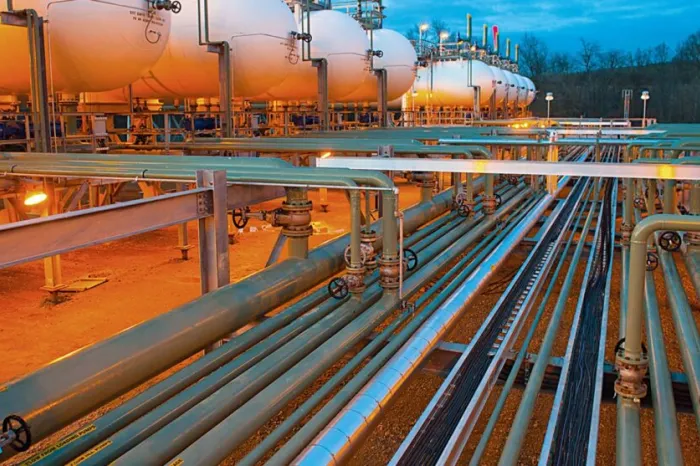
The U.S. Energy Information Administration (EIA) has highlighted significant growth in natural gas pipeline capacity expected to come online across the country in 2026 and 2027. According to the EIA’s latest Natural Gas Pipeline Projects Tracker, nearly 45 billion cubic feet per day (Bcf/d) of new pipeline capacity is planned, with about 70% of this capacity already under construction.
Texas dominates the upcoming expansions, accounting for more than two-thirds of the total new capacity additions. Specifically, approximately 29.7 Bcf/d of pipeline capacity originates from Texas projects. Louisiana follows with about 8.4 Bcf/d, representing nearly one-fifth of the planned capacity increases. Virginia ranks third with an expected addition of 1.6 Bcf/d in 2027.
The expansion in Texas primarily aims to increase takeaway capacity from the Permian Basin, one of the nation’s most prolific natural gas producing regions. This will help alleviate bottlenecks at key hubs like Waha, ensuring smoother delivery of natural gas to liquefied natural gas (LNG) export terminals as well as residential, power generation, and industrial consumers.
Several major pipeline projects are underway or nearing completion in Texas. The Rio Bravo Pipeline Project, a 138-mile line with a capacity of up to 4.5 Bcf/d, is expected to supply feedgas to NextDecade’s Rio Grande LNG export terminal and is slated to begin service in the second half of this year. Another significant development is the Blackcomb Pipeline, a 365-mile pipeline with a capacity of 2.5 Bcf/d scheduled to start operations in the third quarter of 2026. This project will transport gas from the Waha Hub to the Agua Dulce hub, further easing congestion.
The Hugh Brinson Pipeline Project will add another 2.2 Bcf/d of capacity from the Permian Basin, with its first phase expected to flow by late 2026 and the second phase coming online early in 2027. These projects collectively aim to enhance supply chain efficiency and support growing demand for natural gas domestically and internationally.
In Louisiana, two key projects are contributing to pipeline growth. The Port Arthur Pipeline Louisiana Connector is anticipated to begin service in the second half of 2026, offering 2 Bcf/d of additional capacity. Following this, the Pelican Pipeline is projected to come online by the end of 2027, bringing Louisiana’s total new capacity additions to 8.4 Bcf/d.
Virginia’s contribution comes through Williams’ Southeast Supply Enhancement Project, an expansion of its existing Transcontinental Pipeline that will add 1.6 Bcf/d in 2027. This expansion will improve natural gas supply routes from Virginia down to Alabama.
Overall, these infrastructure investments reflect ongoing efforts to meet rising natural gas demand and support LNG export growth from key production regions. The EIA’s data underscores Texas’ pivotal role in expanding pipeline capacity and enhancing market access for natural gas across multiple sectors.