
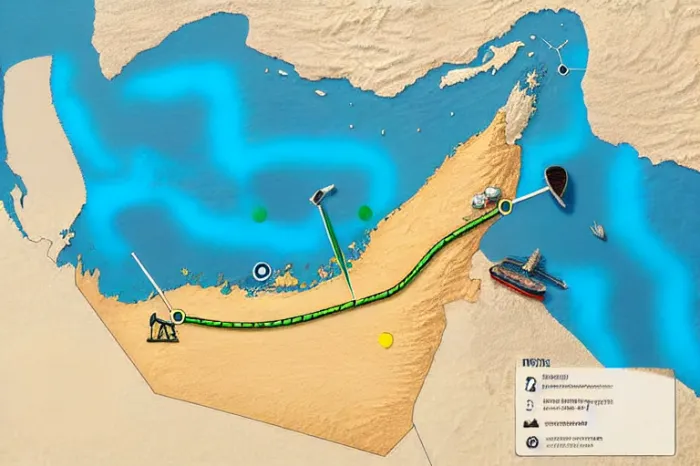
The United Arab Emirates (UAE) is accelerating the construction of a new oil pipeline that will double its export capacity by 2027. This move is part of the UAE’s broader strategy to enhance energy security and reduce dependence on the Strait of Hormuz, a critical but vulnerable shipping route. The new pipeline, known as the West-East 1 Pipeline, will significantly boost the country’s ability to export crude oil directly from the Gulf of Oman coast.
Currently, the UAE’s Abu Dhabi Crude Oil Pipeline (ADCOP), also called the Habshan-Fujairah pipeline, transports up to 1.8 million barrels per day. The planned expansion will raise this capacity to approximately 3.6 million barrels per day, providing a safer alternative to routes passing through the Strait of Hormuz. This strait has been effectively blocked by Iran since February 28 due to ongoing regional conflicts, disrupting about one-fifth of global oil and gas supplies and causing price spikes worldwide.
The UAE and Saudi Arabia are unique among Gulf producers because they maintain pipelines that bypass the Strait of Hormuz. Saudi Arabia has already increased its East-West pipeline capacity to 7 million barrels per day, ensuring that around 60% of its pre-war oil exports continue despite regional instability. Other Gulf countries such as Kuwait, Iraq, Qatar, and Bahrain rely almost entirely on the strait for their oil shipments.
In a significant development, the UAE withdrew from the Organization of the Petroleum Exporting Countries (OPEC) on May 1. This decision allows it to produce and export oil beyond OPEC’s quotas freely. Before recent conflicts escalated, the UAE produced about 3.4 million barrels per day, matching its quota. However, due to disruptions at the Strait of Hormuz, production fell sharply. By May 2024, production capacity had rebounded to around 4.85 million barrels per day, with plans to reach 5 million barrels per day by next year—three years ahead of schedule.
The UAE’s energy minister has stated that production capacity could potentially increase further to 6 million barrels per day if necessary. This expansion would place the UAE on a production level comparable to Canada and ahead of countries like China, Iraq, and Iran in 2024 output figures. ADNOC Drilling, a subsidiary of Abu Dhabi National Oil Company (ADNOC), is prepared to support any needed increases in drilling and production capacity.
The port of Fujairah plays a vital role in this strategy as it serves as a key export hub for oil and other goods. While the Habshan-Fujairah pipeline itself has not been directly targeted during recent conflicts, facilities near its endpoints have suffered attacks from Iranian drones. The port of Fujairah has experienced damages that temporarily disrupted shipments multiple times during ongoing regional tensions. Similarly, Saudi Arabia’s Red Sea port of Yanbu has been attacked in connection with conflicts affecting oil infrastructure.
In response to threats at sea, several tankers carrying UAE oil have navigated through the Strait of Hormuz with their location trackers turned off to avoid Iranian attacks. These developments underscore the risks associated with relying on maritime routes through politically unstable areas.
Overall, the UAE’s pipeline expansion reflects a strategic effort by OPEC member countries in the Gulf region to strengthen their energy infrastructure amid geopolitical challenges. By diversifying export routes and increasing capacity, these countries aim to secure their positions in global oil markets despite ongoing regional conflicts.