
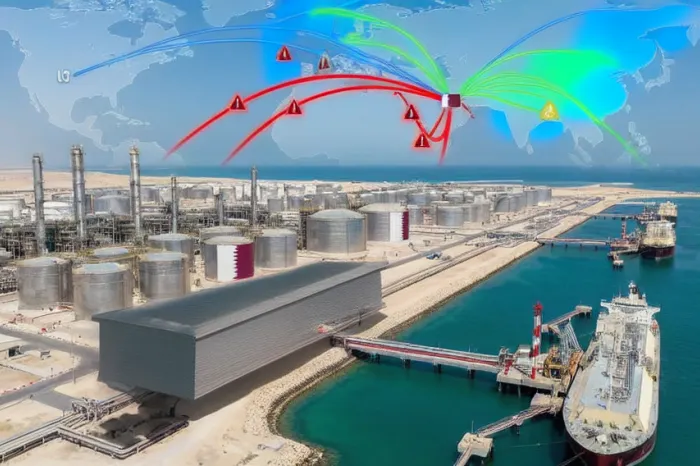
The global natural gas market has experienced a sudden surge in volatility and prices following QatarEnergy’s unexpected halt in liquefied natural gas (LNG) production. This move came after drone attacks targeted key facilities at Ras Laffan, one of the world’s largest LNG production sites. Given that Qatar accounts for about 20% of the global LNG supply, the stoppage immediately impacted energy markets across Europe and Asia, with European natural gas futures rising over 40% and Asian LNG prices jumping nearly 39%. The disruption highlights the vulnerability of global energy supplies to geopolitical tensions.
In the United States, natural gas futures also reacted strongly, climbing 4.44% to $2.99 per million British thermal units (MMBtu). Although the U.S. is currently the world’s largest LNG exporter, its export terminals are operating near full capacity, limiting its immediate ability to offset the shortfall caused by Qatar’s production halt. Nonetheless, the event underscores the long-term importance of U.S. natural gas infrastructure as global demand remains strong.
Key U.S. companies such as CNX Resources and Williams Companies have seen positive market responses amid this supply shock. CNX Resources, which focuses on low-carbon intensity production in Appalachia, has demonstrated strong financial health with consistent free cash flow and a significant share repurchase program. Its operational efficiency and disciplined cost management position it well to benefit from anticipated market tightening expected in 2027, when U.S. LNG exports are forecasted to increase substantially.
Williams Companies plays a crucial role in transporting natural gas across the United States through its extensive pipeline network exceeding 33,000 miles. The company is actively expanding infrastructure to meet growing domestic and export demand. Additionally, Williams is diversifying into power projects supporting data centers, which reflects a broader trend of increasing electrification and energy consumption in new sectors. Its project backlog worth approximately $15 billion and expected adjusted EBITDA growth of over 10% annually through 2030 indicate strong future prospects.
While the current situation has ignited near-term price spikes and volatility, experts caution that it may not lead to a crisis as severe as Europe’s experience during the 2022 gas shortages. However, ongoing geopolitical risks, including tensions affecting shipping lanes like the Strait of Hormuz where LNG traffic has dropped significantly, add layers of uncertainty to global energy security.
Investors face a complex landscape where opportunities exist alongside risks tied to geopolitical developments and infrastructure constraints. Companies with robust balance sheets, efficient operations, and strategic positioning—like CNX Resources with its cost discipline and Williams Companies with its integrated infrastructure—are better equipped to navigate these challenges. The recent price movements reaffirm the growing strategic value of U.S. natural gas exports amid shifting global energy dynamics.
Overall, while short-term disruptions have injected volatility into natural gas markets worldwide, they also highlight the critical role of reliable producers and infrastructure providers in maintaining energy security. The long-term outlook for natural gas remains positive due to increasing demand driven by global economic growth and emerging sectors such as data center electrification.