
The U.S. Energy Information Administration (EIA) has projected that natural gas consumption for electricity generation will remain steady this summer, maintaining levels close to recent years despite a rise in overall electricity demand. According to the EIA’s May Short-Term Energy Outlook, while total electricity use in the United States is expected to increase by 2% during the summer months, natural gas-fired power generation is forecasted to be similar to that of last summer. This balance is largely attributed to the growing contribution of renewable energy sources.
The EIA estimates that natural gas consumption in the electric power sector will average about 43.7 billion cubic feet per day from June through September, matching the consumption seen in the summer of 2025 and exceeding the five-year summer average (2021–2025) by 4%. However, a significant shift is anticipated for the summer of 2027, when natural gas use for power generation is projected to reach a new high of 46.1 billion cubic feet per day. This would surpass the previous record set in 2024 by approximately 3%.
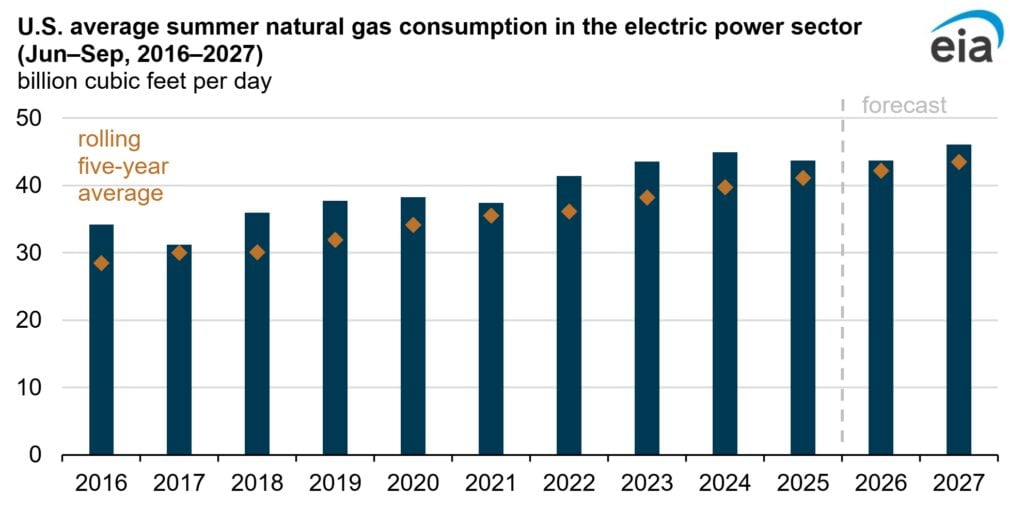
This expected surge in natural gas demand for 2027 is mainly driven by increased electricity sales to commercial and industrial sectors, especially in the West South Central and Mid-Atlantic regions. New data centers and large manufacturing plants, particularly in Texas and Virginia, are key contributors to this growth. The EIA forecasts a 20% rise in commercial and industrial electricity demand in the West South Central region between 2025 and 2027. Additionally, electrification efforts within the oil and natural gas industries are boosting industrial demand for power.
In response to this rising demand, the Electric Reliability Council of Texas (ERCOT) is expected to increase its natural gas and solar power generation significantly. The EIA anticipates a 22% growth in natural gas generation within ERCOT over this period. Meanwhile, the PJM Interconnection region has steadily increased its reliance on natural gas over the past decade as it moves away from coal. PJM’s natural gas generation is forecasted to grow by 6%, while solar power is expected to rise by 32% from 2025 to 2027.
Despite this shift toward cleaner energy sources, coal remains part of the energy mix. The EIA noted that during early 2026, economic conditions favored coal generation in certain regions like the Midcontinent Independent System Operator (MISO). The “dark spread”—a measure comparing coal fuel costs to wholesale electricity prices—was notably higher than the “spark spread” for natural gas during winter events such as Winter Storm Fern.
Overall, the U.S. electricity generation landscape continues evolving with a clear trend toward more renewables and natural gas replacing coal. However, regional differences and sector-specific demands will influence how these energy sources balance out over time. The EIA’s outlook highlights both the stability of current natural gas use and its expected growth tied to expanding commercial activities and industrial electrification.