
The U.S. Energy Information Administration (EIA) has released several key updates on energy production and price forecasts, highlighting trends in ethanol production, biomass fuel sales, and natural gas pricing for 2026 and 2027.
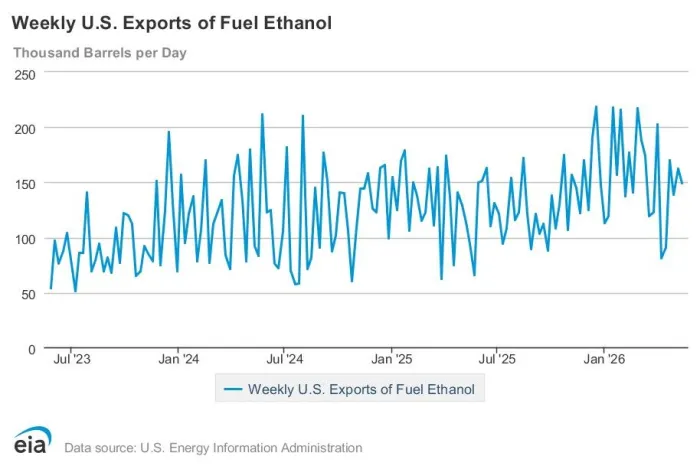
According to the latest weekly data from the EIA, U.S. fuel ethanol production rose by nearly 3% in the week ending May 15, reaching an average of 1.111 million barrels per day. This increase of 29,000 barrels per day from the previous week marks a notable rise compared to the same period last year when production was 75,000 barrels per day lower. While ethanol stocks showed a slight increase to 24.875 million barrels, exports declined by 8%, averaging 149,000 barrels per day. No imports of fuel ethanol were reported during this period.
In addition to ethanol data, the EIA’s Monthly Densified Biomass Fuels Report revealed that U.S. manufacturers produced approximately 900,000 tons of densified biomass fuel in January. Sales exceeded production slightly at 990,000 tons. The report covers data from 73 manufacturers with a combined annual production capacity of over 13 million tons and a workforce equivalent to nearly 2,500 full-time employees. Inventory levels for utility pellets rose sharply to over 725,000 tons by January, up from roughly 493,000 tons in December. Domestic sales of densified biomass fuel reached approximately 143,000 tons at an average price of $242 per ton, while exports accounted for nearly 845,000 tons at an average price of $207 per ton.
The EIA also updated its short-term energy outlook (STEO), lowering the forecasted Henry Hub natural gas spot prices for both 2026 and 2027. The agency now expects average prices to be $3.50 per million British thermal units (MMBtu) in 2026 and $3.18 per MMBtu in 2027. These figures represent a downward revision from the April projections of $3.67 and $3.59 respectively. Quarterly price forecasts indicate fluctuations with prices expected to range between $2.82 and $3.43 per MMBtu across different quarters.
Natural gas production in the Lower 48 states is forecasted to grow steadily, averaging around 118.9 billion cubic feet per day (Bcf/d) in 2026 and rising further to about 124 Bcf/d in 2027. Production increases are largely driven by the Permian Basin, where output is expected to rise by six percent this year due to higher crude oil prices supporting associated gas production. Despite current pipeline constraints causing low spot prices at the Waha Hub in the Permian region, these issues are anticipated to ease later this year with further growth predicted for next year.
The EIA noted that natural gas inventories ended the winter withdrawal season above their five-year average, which helped stabilize prices despite colder-than-normal conditions early in the year. Looking ahead, storage injections during the April through October injection season are expected to be above average, supporting price stability and reducing volatility risks.
These recent reports from the EIA provide a comprehensive picture of evolving dynamics within U.S. energy markets, showing increased ethanol output and biomass fuel sales alongside cautious optimism for natural gas supply growth amid moderated price expectations.