
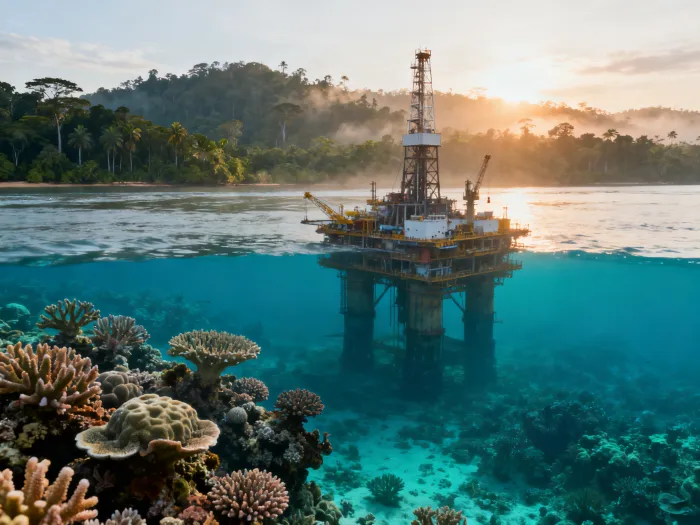
Off the northeastern coast of Brazil, where the vast Amazon River empties into the Atlantic Ocean, two contrasting treasures lie beneath the waves. One is an ecological marvel—a sprawling deepwater coral reef, only recently discovered, that stretches across 3,600 square miles. The other is a vast reserve of oil, buried deep in ancient seabed sediments, which has now become the focus of ambitious drilling initiatives following recent government approvals. The tension between environmental preservation and economic opportunity is palpable in this region.
A few hundred miles to the north, Guyana has undergone a dramatic transformation since the discovery of a massive offshore oil reservoir in 2015. Today, companies extract around 650,000 barrels of oil daily from these deep waters. This once quiet country, covered in rainforest, has swiftly become one of the world’s most significant oil producers per capita, reshaping its economy and global standing.
Further south and inland, Argentina’s Vaca Muerta shale formation marks another frontier in South America’s oil boom. The dusty plains are now dotted with wells tapping into one of the largest shale deposits on the planet. Experts predict output could surpass one million barrels per day by 2030, cementing Argentina’s place among leading global producers.
Across South America, countries are rapidly expanding fossil fuel extraction. Brazil, Guyana, and Argentina stand at the forefront—now among the top five contributors to global oil growth outside OPEC. Despite their distinct economic and political landscapes—a regional powerhouse with environmental ambitions, a biodiverse nation grappling with poverty, and an economically unstable state led by a climate skeptic—they share a commitment to oil development as a pathway to economic advancement.
The Drive for Oil Amid Climate Change Realities
This surge in fossil fuel activity coincides with intensifying climate impacts across South America. Extreme weather events—fires, floods, storms, and prolonged droughts—have claimed lives and devastated communities. These disasters are linked to climate change driven by fossil fuel emissions. Yet as global oil demand remains high and wealthier nations continue their own extraction efforts, South American leaders argue that their region should not be excluded from supplying this essential resource.
Brazil’s recent approval for exploratory drilling at the mouth of the Amazon River is particularly noteworthy. The decision comes just weeks before Belém hosts COP30—a pivotal climate summit focused on reducing greenhouse gas emissions. This juxtaposition highlights Brazil’s balancing act between environmental leadership and fossil fuel expansion.
The continent’s history with oil is longstanding; South America holds the world’s second-largest reserves after the Middle East. For much of the early 21st century, political instability and reluctance toward private investment limited its participation in global oil markets. However, attitudes have shifted markedly in recent years. New discoveries have drawn major investments from multinational companies like ExxonMobil and Chevron, especially as South American oil tends to be cheaper to extract and produces slightly lower emissions per barrel due to newer infrastructure and cleaner energy sources.
Brazil leads regional production thanks to ultra-deep “pre-salt” reserves discovered in 2006 beneath thick layers of ancient oceanic salt. In 2024, crude oil surpassed soybeans as Brazil’s top export for the first time. Recent finds off Rio de Janeiro and exploration prospects near Uruguay further underscore Brazil’s growing prominence.
Controversial Projects and Environmental Concerns
Perhaps the most contentious development is Brazil’s decision to permit drilling in the Foz do Amazonas basin—part of the “Equatorial Margin” along its northern coast. In June, Brazil auctioned offshore blocks in this region—including 19 within the Amazon Basin—to companies such as Chevron, ExxonMobil, and Petrobras. Petrobras had long sought permission to drill here but faced regulatory hurdles over environmental risks.
After years of debate, Brazil’s environmental agency IBAMA approved exploratory drilling following rigorous technical reviews. Officials emphasized that only projects meeting strict scientific and environmental standards would proceed. Petrobras hailed the approval as a societal achievement.
However, environmental advocates warn that drilling in this ecologically sensitive area could have catastrophic consequences. The unique reefs and extensive mangrove forests are vulnerable to oil spills—especially given deep waters and strong currents that could rapidly spread contamination over vast distances. The remote location further complicates emergency response efforts.
These approvals have complicated Brazil’s image ahead of COP30. While most of Brazil’s electricity comes from hydroelectric sources and deforestation rates have declined under President Luiz Inácio Lula da Silva, critics note his longstanding support for oil development—even welcoming past discoveries as national blessings.
Lula rejects accusations of hypocrisy, asserting that oil revenues can fund clean energy transitions without undermining broader environmental goals. Some experts caution that new discoveries risk delaying global progress away from fossil fuels by prolonging reliance on oil infrastructure.
Socioeconomic Impacts: Opportunities and Risks Across the Region
The debate over oil’s role in development is particularly acute in Guyana. Nearly half its population lives on less than $5.50 a day according to World Bank data. The government touts its oil boom as transformative—a chance to lift citizens out of poverty while balancing environmental stewardship.
President Irfaan Ali insists that responsible development can coexist with climate commitments; Guyana’s extensive rainforests absorb more carbon than the country emits. Oil revenues are earmarked for social programs and economic growth.
Yet concerns persist about falling into the “resource curse”—a phenomenon where resource wealth leads to economic instability or authoritarian governance rather than widespread prosperity. Venezuela offers a cautionary tale: despite holding the world’s largest proven reserves, it faces severe political and economic turmoil.
Guyana’s leadership maintains that careful management will ensure benefits reach all households. Nonetheless, some residents cite rising living costs linked to oil development while health outcomes lag behind regional averages.
Argentina’s Vaca Muerta represents another pillar of South America’s energy future. The shale field contains vast reserves of gas and oil—second only to those found in Texas’ Permian Basin globally for shale gas and fourth for shale oil. Under President Javier Milei’s administration, expanding Vaca Muerta is central to Argentina’s recovery strategy.
Oil investments are attractive due to flexible spending structures; companies can test profitability before committing fully—an advantage amid Argentina’s unpredictable political climate. However, environmentalists warn about fracking’s hazards: intensive water use mixed with sand and chemicals poses risks to local ecosystems.
Uncertainty Amid Global Shifts in Energy Demand
South America’s future as an oil powerhouse remains uncertain. New discoveries may prove less viable than anticipated; existing reserves can deplete faster than expected according to industry experts like UCLA’s Michael Ross.
Moreover, forecasts suggest global demand for oil will peak early next decade—a timeline that could leave aggressive producers vulnerable if markets contract sharply afterward. “These countries are getting to the party right as the bar is closing,” Ross cautions.
Nevertheless, investment continues while demand outpaces supply. Geopolitical shifts may further elevate South America’s importance if U.S. production plateaus or declines; otherwise reliance on suppliers like Saudi Arabia or Russia could increase.
Gabriel Blanco from Argentina sees these trends as part of a broader global consensus favoring continued fossil fuel exploitation despite mounting climate risks—a sentiment echoed by regional leaders who prioritize immediate economic gains over longer-term sustainability concerns.
In summary, South America’s ascendance in global oil markets reflects both opportunity and challenge: nations strive for economic growth even as they grapple with profound environmental questions posed by accelerating climate change.
Related topics: